
A Customer Intelligence Platform in 5 Steps
A Journey from Data to Insights to Actions to Outcomes
Customers are not homogenous, and they don't want to be treated that way.
From over three decades of consulting experience, I've found that most executives believe they know what their customers want when making purchase decisions. And most are partially correct.
But their inaccuracy lies in subconsciously inflicting their own bias, trusting unsupported assumptions, believing customer wants are static, and assuming all customer wants translate into a willingness to pay. Even small inaccuracies in customer intelligence create downstream losses in marketing and sales conversions.
In the legendary words of Mark Twain, "What gets us into trouble is not what we don't know. It's what we know for sure that just ain't so."
A Customer Intelligence Platform solves this challenge.
Even better, it delivers hyper-personalized engagement that improves customers experiences and company conversions automatically and at scale.
And it can be created in a 5-step process.
Transform Data into Unified Customer Profiles
A Customer Intelligence Platform combines customer data from multiple sources and consolidates it into unified customer profiles. This cures the problem of data silos, duplicate data, and multiple versions of the truth.
The data transformation goes through the following 4-step process:
- Unify first and third-party customer data.
- Aggregate, consolidate, enrich and deduplicate customer data. Combine client data from multiple sources and consolidate it into unified customer profiles.
- Apply data cleansing routines. This is important as client data depreciates at about 2% per month.
- Stage the data in the CRM application. Your CRM application is the customer system of record and should be the central source for all information.
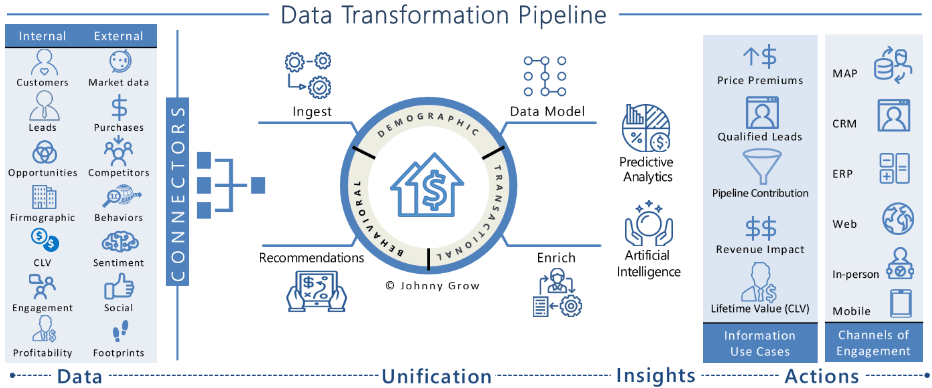
Data transformation is the first step to convert data from an unused byproduct to actionable information. When done at scale, this transforms data from a raw material to the company's most valuable asset.
Setup Your CRM 360-degree Customer View
The CRM system is an integral component of a customer intelligence platform. It can easily create customer personas and segments. It can calculate customer engagement or account health scores. It can measure the fit for each customer against your Ideal Customer Profile (ICP).
It can organize the data to facilitate high value use cases. For example, the right data will improve sale opportunity conversions, account upsell and customer retention.

A 360-degree customer view helps staff to see everything in one place.
However, while this is a frequently bantered goal, Gartner advises less than 10% of companies actually achieve it. To do better, you need to harvest 5 types of customer data – demographic, transactional, behavioral, environmental and social.

Pretty much every CRM vendor claims to deliver a 360-degree customer view. But most don't. What most offer is a customer view with account firmographics and contact demographics. It's a start, but customers are far better defined by their behaviors than their demographics.
Demographics are explicit data while behaviors are implicit data. Explicit data such as company size and industry only indicate how interested the company is in the customer. Implicit data such as online behaviors, digital footprints, sentiment analysis and social graph show how interested the customer is in the company.
Harvest the Voice of the Customer
Customer intelligence enables companies to understand customers on an individual basis. It allows them to achieve the strategic goal of delivering relevant, personalized and contextual communications and offers.
- Relevant – is your engagement important to the recipient? Does it address a pain point?
- Personalized – is your engagement based on the recipient's role, title, industry, behaviors and interests (determined from digital footprints)?
- Contextual – is your message based on what's needed at this point in time?
When the company sends communications that resonate, as opposed to generic or irrelevant offers, clients believe you actually know them and are doing your part to contribute to a real relationship. They also take advantage of those offers more frequently thereby boosting conversion rates and customer lifetime value.
But if you find you lack data for hyper-personalized messaging, consider some additional techniques. One of the best is a Voice of the Customer (VoC) program.
This program replaces intuition and guesswork with firsthand information from customers.
A VoC program captures, categorizes and prioritizes customer goals, expectations, preferences and dislikes. This data feeds your CRM software customer 360-degree view. It ensures customer expectations and insights are easily accessible in one place and can be used by any employee for an improved customer experience.

Only with VoC can you discover what is most important to your customers and design the marketing campaigns, sales processes and differentiated customer experiences that achieve improved results.
An Aberdeen report titled The Business Value of Building a Best-in-Class VoC Program found that simply implementing a VoC program and capturing data without a clear intent for that data resulted in a short-lived unsuccessful program.
However, the report also found that the top 20% of respondents who applied the data to sales and marketing programs achieved:
- 292% higher engagement rates
- 55% higher customer retention rates
- 23% decrease in yearly customer service expenses
Knowing exactly what customers want drives precision marketing programs and avoids investing in things that don't matter.
Other customer feedback methods include crowdsourcing, social listening, market intelligence graphs, white space mapping, NPS surveys, IoT and telemetry.
Use Analytics to Generate Insights
Now you can apply analytics to assemble more precise audience building, buyer engagement, journey orchestration, customer insights, and performance measures.
For example, to drive profitable growth, you will need to compare customer acquisition cost (CAC) and customer lifetime value (CLV or LTV). For most companies, the ratio of CLV to CAC should be 3 or greater and show a payback of less than 18 months.
CRM and AI are the primary tools to convert data into actionable insights. Sometimes low code BI tools such as Power BI and Tableau are used.
These insights are powerful. They go beyond performance measures and advise which buyers will buy, which sale opportunities will close, and which clients will churn. They show which selling actions will advance an opportunity, and how salespeople can better allocate their scarce time to produce better results.
Here are some additional examples:
- Predictive lead scoring. Analytics such as predictive AI look at things like ICP fit, prospect firmographics, buyer behaviors and historical data of look-alike accounts. They then calculate a score that shows the likelihood of purchase. They can also provide recommendations to improve the score.
- Suggested talk points. Analytics such as generative AI apply your company content, sale methodology, customer pain points or position in the sales process to suggest precise messaging that resonates.
- Guided sales execution. A notification may advise when to requalify a lead, when a sale opportunity needs an improved sales strategy or win plan, or when a prospect needs more frequent engagement. It's sort of like an online sales coach.
- Next best content. With some advanced mapping, the system will suggest the most effective company content or collaterals at any point in the customer journey. Below is an illustration of how we map content to the buyer's purchase process.
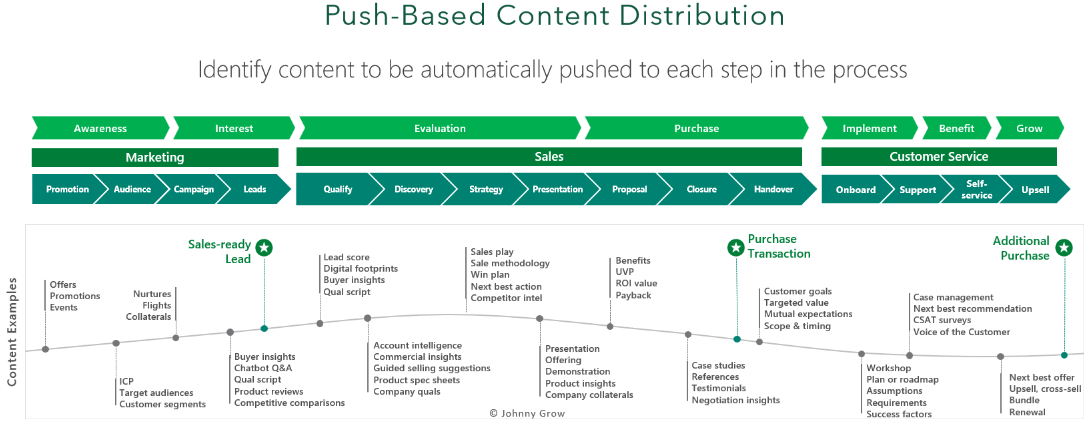
Analytics tools also define the right metrics to track progress and prompt real-time corrective action when variances occur. In fact, if your reporting is not continuously suggesting, adjusting or reprioritizing suggested actions, it's not working.
Push Insights to Where They Can be Used
Insights become valuable when they are used to improve strategies and tactics that acquire, grow and retain customers. Here are some examples of turning insights into actions.
- Marketers use buyer insights to deliver personalized and relevant messaging that increases campaign conversions and acquires higher quality leads. Customer data is the single best source to create better-targeted campaigns with more focused value propositions that resonate with buyers.
- Salespeople use customer data to qualify new leads, score opportunities and deliver the right message and each step of the sales cycle. For existing customers, salespeople will use customer insights to improve intelligent cross-sell and up-sell recommendations.
- Customer service reps will use insights to improve customer satisfaction, deliver differentiated customer experiences, and identify customers at-risk of churn.
- Product management or R&D use insights to build products that achieve more enthusiastic adoption and greater utilization. They know the best source for innovation is feedback from the people who will actually buy and use their products.
- Company strategists use insights to identify white space, new revenue streams and industry disruption opportunities.
To get the most leverage, you can use CRM and AI workflow tools to push insights to where they can be used.
AI has become the top next-best-action or recommendation engine for customer facing staff. Its algorithmic calculations intelligently weigh all available data to deliver highly accurate recommendations that get better over time.
Buyer and customer insights are normally displayed as on-screen messages. This is generally done using CRM alerts, notifications, dialogues or prompts.
But there are other distribution methods. For example, buyer insights shared among customers or customer segments may be pushed to a dashboard.

Alternatively, buyer insights may be persona-based findings that reveal when, why and how a customer makes purchase decisions. These insights provide guidance to know what's most important to the buyer and allow the seller to focus on advancing the buyer's purchase process. Therefore, they should be pushed to the CRM contact record.

Personas such as the above are archetypes that mimic and represent real customers. They are fictitious character profiles described with gender neutral names, visualized with figurative portraits and aligned with marketing and sales strategies.
Your Customer Intelligence Platform is Waiting
Most companies already have the data for a customer intelligence platform. They have the buyer digital footprints, recorded sales conversations, exchange data from email and calendars, and seller activities in CRM.
They just need to harvest and transform that raw data into actionable insights. Their system can then deliver real-time guidance and recommend in-the-moment actions, engagement or content to improve business outcomes.
Or it can deliver relevant, personalized and contextual engagement to every customer every time.
Even better, it can apply automation to deliver personalized experiences at scale.
However, it can be a difficult journey.
We found that sales, marketing, customer service, and tech organization professionals' top two challenges with CRM: creating a single view of customer data and information (64%) and creating customer insight to drive decision making (53%).
— Source: Kate Leggett, CRM Analyst, Forrester
Sometimes companies need some assistance. Fortunately, there are partners that can help.
Johnny Grow is one of those partners. Our CRM analytics practitioners have been implementing customer intelligence platform systems for more than two decades.
We are well versed in technologies such as CRM, AI and enterprise analytics. Our consultants bring research-based insights, evidence-based best practices, prescriptive methods, and the tools shared in this post to accelerate the delivery of a technology solution that achieves essential business objectives.