
Lessons from a Business Development Consultant
6 Recommendations from a Business Development Consultant
A business development consultant can spend his or her career implementing strategies, best practices and technologies that create sustained company growth.
But how do they help? Or how should they help to drive the maximum impact in the least time?
Having done this for more than three decades, I compiled a short list of actions that deliver the biggest upside results.
So, before you consider your next biz dev program, consider how the below recommendations can work for your company.
Begin with a Clear Scope and Specific Objectives
Business development is a broad term. So, it's important to begin with a clear scope and specific goals.
For some companies, it's a strategic effort. The strategy may include customer expansion, new markets, product introductions or acquisitions.
For other companies, it's all about increased sales growth. It's an execution-based effort focused on methods to attract, engage and convert more customers.
I've found it helpful to share research that shows what's possible using a combination of best practices, business process optimization, and technology automation. Some of the benefits of a successful business development program are shown below.

The Go-to-Market Plan
Once you have clear goals it's time to create the execution plan. Many companies refer to this as their Go-to-Market Plan.
It brings specificity and measurability to the actions that deliver desired results. It shows how to assemble strategies, best practices, actions, and resources into a dynamic blueprint.
When done well, it lowers management's administrative burden and brings real-time visibility to progress. It also help managers quickly respond to market changes or performance variances.
The Johnny Grow consultants have found that an interactive one-page blueprint is far more powerful than a lengthy report that gets shelved. An example is shown below.

A Best Practices Approach
Growth plans without supporting methods are just wishful thinking.
A systemic approach is needed to achieve sustained results. Otherwise, piecemeal efforts generally lead to tactical and temporary outcomes.
What's needed to achieve extraordinary results is a methodology that applies a combination of proven growth methods, evidence-based best practices, and platform technologies.
As an example, the methodology used by Johnny Grow is shown below.

Biz dev recommendations without supporting data are just opinions. That's why each of the above best practices is validated by field research, implemented with a prescriptive framework, measured with purpose-built analytics, and automated with technology. And because best practices are data driven, they can be modeled to show investment, cash flow impact, time to value and payback.
Process Optimization
Inefficient processes are a top impediment to biz dev programs. Failing to remedy inefficiencies in how work gets done creates headwinds for company expansion.
Business process improvement consulting is frequently needed to improve company performance. But keep two things in mind.
Frist, process optimization is a three-step progression. You need to simplify, streamline and automate, in that order. There is no sense in automating inefficient processes.
Second, there are two proven methods to achieve this three-step progression.
One is Universal Process Notation (UPN). It's a good starting point for processes that are not yet simplified. An example is shown below.

Each step can drill down to see supporting details. This is where you identify the step's purpose, input, output, effort and value. Some steps will also include the role owner, approval process or exception conditions.

A UPN process map should be limited to 8–10 steps. There is no limit to the number of levels in the diagram. A process map will effectively design the steps and details so you can reduce errors, increase efficiencies, eliminate waste, and achieve targeted results.
"85% of the reasons for failure are deficiencies in the systems and process rather than the employee. The role of management is to change the process rather than badgering individuals to do better." —W. Edwards Deming
The second method is Agile Value Stream mapping. It is particularly well suited to saving time by removing redundancies and non-value-added activities.

Process improvements lower labor cost, accelerate cycles and allow the company to scale operations without scaling resources. They also set you up for automation, which takes us to the next recommendation.
Technology Automation
Technology is a not-so-secret ingredient to simultaneously lower operating costs and accelerate biz dev results.
The three technologies that most help are workflow tools, AI and process mining.
Workflow tools often reside within your existing CRM or ERP application. They use visual designers to sequence and automate activities. They can present dialogues for user interaction or run autonomously. They can operate in real-time or asynchronously.

Artificial intelligence is a transformational technology. However, it's not a single technology. It's a suite of apps where each has a unique purpose.
For example, the three dominant types of AI are shown below.
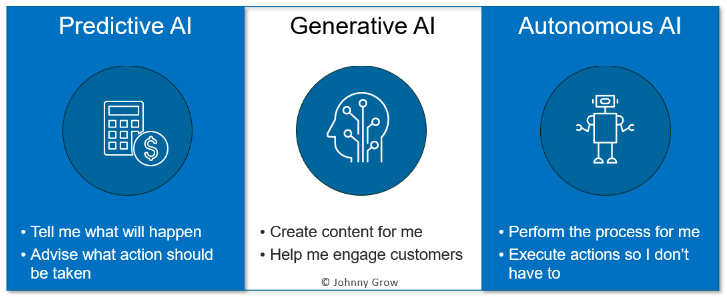
You will realize the biggest successes when you start with the most important business outcomes and then work backwards using one of the above AI technologies to achieve them.
Process mining applications analyze work streams and their output. They ingest event logs and related data to visually display end-to-end company flows. They then make recommendations to optimize those journeys in ways that accelerate throughput, reduce deviations, and improve effectiveness.

While the need for technology is a no brainer, technology operation is anything but.
Many companies struggle with fragmented applications and many data siloes.
A smart approach is to assemble a strategically designed Tech stack. This will replace ad hoc and piecemeal systems with a holistic architecture to acquire, grow and retain customers at scale.
An example is shown below.

A good tech stack maximizes technology investments and future-proofs procurement decisions. It also consolidates data siloes for easier and more effective reporting. That takes us to the final recommendation.
Business Intelligence
Many companies are data rich and information poor. Business Intelligence (BI) tools can fix that.
BI dashboards, reports and predictive analytics are the tools to get the right information to the right person at the right time. These tools enable staff to achieve a business outcome, improve a customer interaction, or make a more informed decision. Sometimes they help staff immediately intervene to resolve a performance deviation.
Instrumenting your performance with real-time key performance indicators allows you to know what's working, what's not and intervene with timely course corrections.

Smart businesses are defined by their ability to collect and curate the right data and apply analytics to make insights actionable at the point of decision. Smart businesses make better decisions more often. It's a complex undertaking which is why those who succeed will achieve competitive advantage over those who don't.
A Business Development Consultant Can Help
Identifying, prioritizing and executing a biz dev program is a complex undertaking.
Fortunately, there are partners that can help.
Johnny Grow is one of those partners. Growing companies is our core competency.
Our staff of business development consultant specialists bring research-based insights, evidence-based best practices, prescriptive methods, and the tools referenced in this post to help clients achieve significant and sustained company growth.